


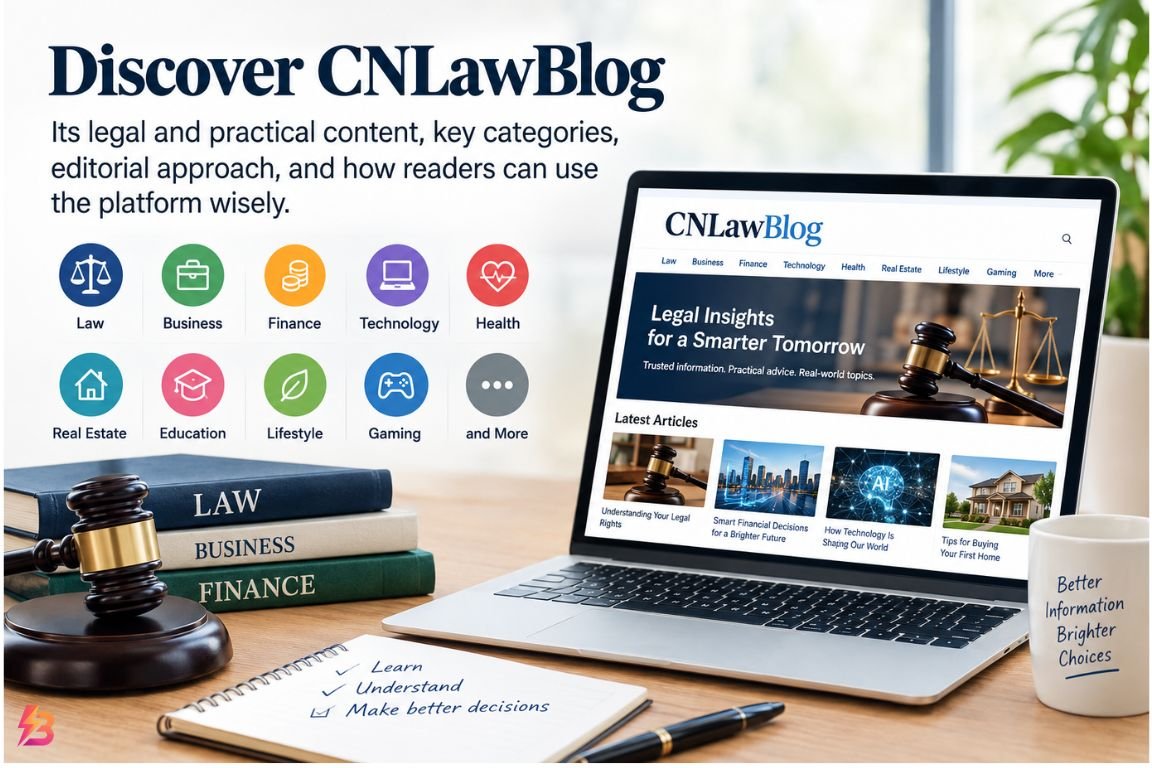
If you came across cnlawblog while looking for legal information, you may expect a website focused exclusively on law. The current platform is broader. CNLawBlog.com presents itself as an independent digital publication covering law alongside technology, business, finance, education, health, real estate, lifestyle, gaming, and other practical subjects.
The site aims to make complicated subjects easier to understand through structured articles and accessible explanations. Its law section includes areas such as accident law, civil law, corporate law, criminal law, family law, and personal injury law.
This guide explains what cnlawblog is, what readers can find on the platform, how its editorial process works, and why the exact website address matters when researching legal information.
What Is CNLawBlog?
CNLawBlog is an independent online publication designed to provide informational content in a clear and accessible format. According to its About page, the publication was founded in August 2018 and developed from a strong legal publishing foundation into a broader knowledge platform.
The website now covers several major subject areas. Law remains a prominent category, but readers can also find content related to finance, business, technology, education, health, real estate, lifestyle, gaming, and consumer information.
That broad editorial scope makes the website different from a traditional law-firm blog or specialist legal database. Instead, it functions as a general information resource with a substantial legal section.
The platform’s stated goal is to explain complex subjects in language that readers can understand without requiring specialist knowledge. This approach can be particularly useful for people who need an introduction to a topic before deciding whether they need more specialized resources.
When Was CNLawBlog Established?
The site’s About page states that cnlawblog was founded in August 2018. The publication says its original foundation was closely connected with legal content before expanding into additional subject areas.
The current website also contains older material alongside newer articles. Its homepage shows content from different periods, while recent posts cover subjects ranging from law and finance to technology and gaming.
This history helps explain why visitors may encounter different types of articles when browsing the domain. The site has developed beyond a narrow legal-blog model.
What Topics Does CNLawBlog Cover?
The strongest feature of cnlawblog is its range of categories. The current website lists law, technology, finance, business, education, health, lifestyle, and real estate, with additional categories under its broader navigation.
The platform also publishes content related to travel, automotive, fashion, politics, sports, and gaming. This creates a mixed information environment rather than a publication dedicated to one professional discipline.
The main categories can be understood as follows:
- Law: Legal concepts, disputes, rights, responsibilities, and legal services.
- Business: Business developments, entrepreneurship, and commercial subjects.
- Finance: Loans, investing, interest rates, financial products, and consumer finance.
- Technology: Digital innovation, artificial intelligence, and technology-related developments.
- Education: Learning and educational subjects.
- Health: General health and wellness information.
- Real Estate: Property and housing-related topics.
- Lifestyle: Everyday subjects and practical guides.
- Gaming: Gaming guides and related entertainment content.
The variety means readers should check the category and individual article before assuming that every page follows the same professional or technical standard.
Understanding the Legal Section
The legal section is central to the identity of cnlawblog, even though the overall website now covers many other subjects.
The site’s law navigation includes accident law, civil law, corporate law, criminal law, family law, personal injury law, and a CNLaw category.
Accident and Personal Injury Law
These categories can help readers understand general concepts surrounding accidents, injuries, claims, and legal representation.
For example, someone researching an injury-related issue may first need to understand basic terminology before discussing a situation with a qualified attorney. Educational content can provide that starting point without replacing case-specific advice.
Civil Law
Civil law content can introduce readers to disputes between individuals, organizations, or other parties.
Topics in this area can include contracts, property disputes, legal obligations, damages, and remedies. The exact rules, however, depend heavily on the jurisdiction involved.
Corporate Law
Corporate law is especially relevant to business owners, entrepreneurs, companies, and professionals.
Articles in this area can help readers understand concepts such as corporate responsibilities, business structures, governance, contracts, and compliance. Businesses dealing with a specific legal issue should still examine the laws that apply to their location and industry.
Criminal Law
Criminal law concerns offenses, legal procedures, rights, and potential consequences.
Because criminal matters can involve serious penalties and strict deadlines, general online articles should serve as educational starting points rather than personalized legal advice.
Family Law
Family law can involve subjects such as marriage, divorce, custody, support, and other family-related legal matters.
These cases often depend on individual circumstances and local legislation. Readers can use educational material to learn terminology and prepare questions, but professional guidance may be necessary for an active dispute.
CNLawBlog and Business Information
Business readers can also find useful material on the platform. The site’s broader editorial mission includes business and entrepreneurship, giving readers access to information that goes beyond traditional legal topics.
For an entrepreneur, legal and business knowledge often overlap. Starting a company, signing agreements, hiring workers, protecting intellectual property, or handling regulatory requirements can involve several different areas of law.
A general information platform can help readers identify the questions they need to investigate. For example, a business owner might learn the difference between a contract term and a regulatory requirement before consulting a specialist.
That preliminary understanding can make professional conversations more productive because the reader already understands the basic terminology.
Technology, Finance, and Other Categories
The current homepage demonstrates how far the publication has expanded beyond law. Recent content includes subjects such as private equity, online loan scams, medical equipment financing, Federal Reserve interest rates, Treasury yields, edge artificial intelligence, gaming, and screen time.
This range reflects a broader editorial strategy.
Technology
Technology content can cover developments in artificial intelligence, digital systems, data, and emerging technologies. These topics change quickly, so publication dates and updates are particularly relevant.
Finance
Financial articles can introduce readers to loans, interest rates, investments, and financial risks. Since financial products and economic conditions can change, readers should pay attention to dates and verify important figures before making decisions.
Lifestyle and Consumer Topics
The website also publishes practical lifestyle and consumer-oriented material. These articles can address everyday questions that do not necessarily require specialist expertise.
The result is a platform that serves several different reading purposes rather than functioning as a single-topic legal publication.
How the Editorial Process Works
One of the more useful aspects of cnlawblog is its published Editorial Policy. The policy says articles are developed through stages that include topic selection, research, writing, editorial review, publication, and later updates when appropriate.
The policy identifies several editorial principles:
- Accuracy
- Clarity
- Relevance
- Transparency
- Continuous improvement
The stated research process may involve government websites, official organizations, academic publications, industry documentation, technical references, manufacturer documentation, and public reports, depending on the subject.
The site also says articles undergo review for factual consistency, grammar, readability, organization, formatting, internal linking, and overall quality.
Another notable point is the site’s approach to updates. Its policy explains that articles may be revised when laws, regulations, technology, industry standards, or other relevant information changes.
That matters for legal and financial subjects because information can become outdated even when an older article was accurate when first published.
Who Can Benefit From CNLawBlog?
CNLawBlog can be useful for several types of readers, particularly those who need an accessible introduction to an unfamiliar subject.
Students
Students can use explanatory articles to reinforce basic concepts and develop vocabulary before moving to textbooks, academic sources, or primary legal materials.
Business Owners
Entrepreneurs can use general legal and business content to identify issues involving contracts, compliance, company operations, and commercial responsibilities.
Professionals
Professionals may use concise articles as background reading when they need a quick overview of an unfamiliar subject.
General Readers
People without professional training can use the platform to become more familiar with legal terminology, financial concepts, technology topics, and everyday issues.
The most effective approach is to treat general articles as a starting point. A reader should move to authoritative or professional sources when the decision involves significant legal, financial, medical, or business consequences.
Is CNLawBlog a Law Firm?
No. The website describes itself as an independent digital publication rather than a law firm. Its own materials also state that legal information should not replace professional legal advice when specific guidance is required.
That distinction is essential.
A legal article can explain a concept without creating an attorney-client relationship. It also cannot account for every detail of an individual’s case.
For example, two people may face similar disputes but have different outcomes because of their location, contracts, evidence, deadlines, or procedural history.
Readers facing an active legal matter should therefore use online articles for background knowledge and consult a qualified lawyer for advice concerning their particular circumstances.
CNLawBlog vs. China Law Blog
One of the easiest mistakes when researching cnlawblog is confusing CNLawBlog.com with similarly named China-focused legal publications.
The names may look similar, but they are not automatically the same organization.
CNLawBlog.com describes itself as a broad independent publication covering law and numerous non-legal categories. By contrast, the publication known as China Law Blog is associated with Harris Sliwoski and focuses specifically on Chinese and international business law.
That difference matters when researching subjects such as Chinese regulations, foreign investment, international contracts, manufacturing, trade, or disputes.
The domain is therefore worth checking before relying on an article. A similar title does not establish that two websites share ownership, authors, or editorial standards.
How to Use Online Legal Content Responsibly
Legal information is most useful when readers understand its limits.
A practical approach is to follow these steps:
- Check the website and author. Confirm who published the material and whether the author has relevant expertise.
- Check the publication date. Laws, regulations, and policies can change.
- Identify the jurisdiction. A legal rule in one country or state may not apply elsewhere.
- Look for supporting sources. Government publications, legislation, court decisions, and official regulatory material can provide stronger authority.
- Separate education from advice. An explanatory article can improve understanding without applying the law to your individual situation.
- Get professional help when necessary. Significant legal disputes deserve advice based on the actual facts and documents.
This approach does not make online legal content less useful. Instead, it places each source in the right context.
What Makes a Legal Article Useful?
A strong legal article should do more than repeat legal terminology.
It should explain the central concept in plain language, identify the relevant context, distinguish general principles from exceptions, and direct readers toward appropriate next steps.
Good structure also matters. Clear headings allow readers to locate the information they need without reading every paragraph.
CNLawBlog’s Editorial Policy emphasizes clarity, relevance, logical organization, readable language, and practical explanations. It also says the publication may update material when new information improves its accuracy or usefulness.
For readers, these standards provide a useful framework for evaluating any online legal resource, not just one website.
FAQs
What is CNLawBlog?
CNLawBlog.com is an independent digital publication covering law, business, finance, technology, education, health, real estate, lifestyle, gaming, and other practical subjects.
Is CNLawBlog a law firm?
No. CNLawBlog.com presents itself as an informational publication, not a law firm. Its legal articles are intended to educate readers rather than provide individualized legal representation.
What legal topics does CNLawBlog cover?
Its law categories include accident law, civil law, corporate law, criminal law, family law, personal injury law, and CNLaw.
Is CNLawBlog the same as China Law Blog?
No. CNLawBlog.com and China Law Blog are separate publications. Readers researching Chinese law should check the exact domain and publisher before using a source.
Can I rely on CNLawBlog for legal advice?
You can use its articles for general education and background information. For a specific legal dispute, contract, claim, criminal matter, or other significant issue, consult a qualified legal professional who can assess the facts and applicable law.
Conclusion
CNLawBlog has developed into a broad digital publication rather than a website devoted solely to legal material. Its current coverage spans law, business, finance, technology, education, health, real estate, lifestyle, gaming, and other practical subjects.
Its legal categories make the platform useful for readers who want accessible introductions to subjects such as civil, corporate, criminal, family, accident, and personal injury law. At the same time, the site’s wider content makes it important to assess each article according to its topic, date, jurisdiction, author, and supporting sources.
The biggest takeaway is simple: cnlawblog can be a useful starting point for learning, but readers should distinguish general information from professional advice and check the exact domain when similar legal websites appear in search results.
